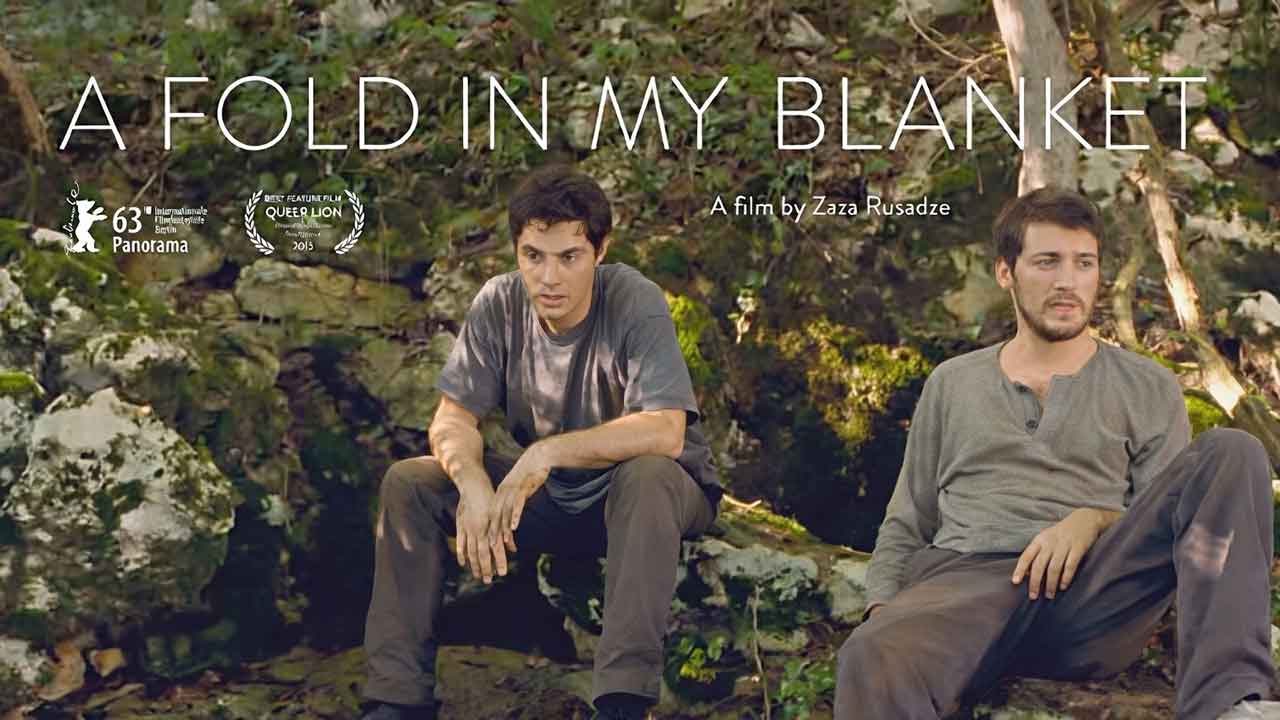



A small Georgian town where everyone knows your story before you open your mouth. Dmitrij climbs to escape, but a stranger named Andrei pulls him into a reality where truth can be rehearsed.


Some films don’t “begin”. They move in. Quietly. Like a relative who shows up for the weekend and somehow is still there three months later, using your best mug and asking what you’re doing with your life.
A Fold in My Blanket is that kind of movie. It settles into a small Georgian town with the confidence of something that’s been stuck there forever. The story says “near future”, but the air feels old: old habits, old rules, old glances that say ten sentences without moving a single facial muscle.
Our guy is Dmitrij. He’s back from abroad, which in small towns is basically a tattoo on your forehead. People look at him like he brought a new disease and a new attitude in the same suitcase. He works at the court, which means his daily life is paperwork, routines, and the kind of authority that doesn’t need to raise its voice. It just waits. And you break yourself against it.
A town that runs on pressure
What I love (and by love I mean “this film made my shoulders tense”) is how the town feels like one big closed room. Every conversation is slightly off. Every polite moment has a knife hidden somewhere in the grammar. Family gatherings don’t feel warm, they feel like rehearsals: say the right thing, laugh at the right place, don’t trigger the wrong person, and for the love of God don’t bring up anything real.
And then there’s Irina, the aunt who drifts between paranoia and prophecy. People treat her like background noise, a person you label so you don’t have to hear her. The film doesn’t play her for cheap laughs. It uses her as a warning sign: in this place, when you start slipping, nobody catches you. They just step around you and continue eating cake.
Climbing as a way to breathe
Dmitrij’s escape is climbing. Not the sporty, Instagram version. This is climbing as oxygen. When he’s on the rock, the town can’t reach him. No one can lecture him, judge him, whisper about him, or squeeze him into their idea of what a “normal man” should look like. Up there, he gets silence that actually feels like silence, not social punishment.
Then Andrei appears. A stranger with that vibe of someone who could be real, or could be a projection Dmitrij desperately needs. Their connection is the film’s quiet pulse. It’s not presented as a clean “romance storyline” with neon signs. It’s closeness, curiosity, the kind of intimacy that feels dangerous mainly because the town has already decided what it will allow you to be.
And the film is smart enough to know that desire doesn’t always arrive as a declaration. Sometimes it arrives as a shared cigarette, a look held a second too long, a moment where you realize your life has been a performance and you’re tired of acting.
Truth, testimony, and the art of lying to survive
Here’s where A Fold in My Blanket starts folding reality in on itself. Andrei goes missing. A murder case surfaces. Dmitrij, who is already living with a low-level internal panic, steps into the story with an alibi. He says they were together, climbing, camping outside the city.
Sounds simple. Except nothing in this film stays simple for more than thirty seconds.
The court wants certainty. The town wants a neat narrative. People want the comfort of “we know what happened”. Dmitrij offers a story, but the film keeps asking: is it true, is it a lie, or is it something worse, a memory he invented so hard it started behaving like fact?
At some point you realize the courtroom isn’t about justice. It’s about control. A witness hesitates, details shift, confidence evaporates, and suddenly you’re watching truth turn into a costume that gets adjusted depending on who’s looking.
And Dmitrij is right in the middle of it, not as a heroic whistleblower or a brilliant detective, but as a human being whose inner world is starting to leak into the outer one. The film doesn’t scream “unreliable narrator”. It just quietly rearranges the furniture while you’re standing in the room.
That bleak, dry humor
People sometimes call this a black comedy, and yes, but don’t expect punchlines. This is humor so dry it could survive a desert. It’s the comedy of social suffocation: the absurdity of polite cruelty, the way everyone knows everyone’s business but still pretends they don’t, the way a town can be both intimate and completely loveless at the same time.
The laughs, when they come, aren’t “haha”. They’re “oh no, that’s exactly how people are”.
What the film is really doing
Under the plot, this is a film about identity under pressure. About what happens when your environment has already written your script and you’re trying to improvise. Dmitrij is not simply hiding a desire or a secret. He’s trying to find a version of himself that can exist without immediately being corrected by other people’s expectations.
And the “near future” detail suddenly makes sense: it’s a small nudge that says, even if time moves forward, places like this can stay the same. Technology changes. The social weather doesn’t.
The climbing scenes are not there to “add action”. They’re there to show contrast: open space vs tight rooms, risk you choose vs risk forced on you, silence that heals vs silence that punishes.
Should you watch it?
If you like films that trust your patience, absolutely. This is slow, but not empty. It’s slow the way a storm builds. It’s mood and psychology and little human cruelties stacked on top of each other until you feel the weight.
If you need a clean mystery, a clear resolution, and characters who announce their feelings like a TED Talk, this will frustrate you. On purpose. This film doesn’t hand you answers. It hands you uncertainty and asks you to sit with it. Like the town does. Like Dmitrij does.
By the end, you’re left with a question that’s nastier than “who did it”: how much of your life is truth, and how much is a story you tell because it’s the only way to keep breathing?
And yeah, that’s a fold in the blanket you don’t easily iron out.