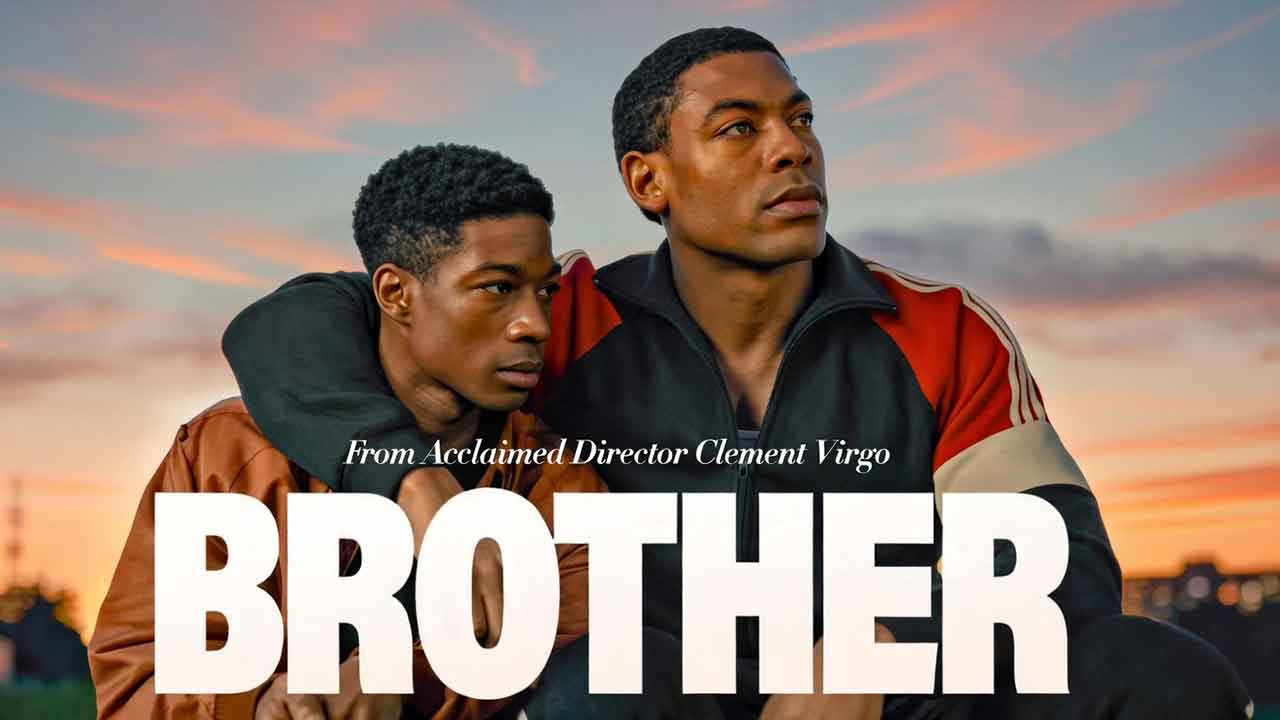



Brother doesn’t chase big plot twists. It chases the things you try to forget – the day the neighborhood stopped feeling safe, the moment “be a man” became a sentence, not advice. It’s a film about two brothers and one question that never shuts up: what does survival cost, and who ends up paying?


Brother (2022) opens like a warning label you can’t peel off. A big brother teaches a little brother how to climb an electrical pole, where every step is a choice, every move is risk. Miss your footing and you get zapped. But if you do it right, you “put it in memory”. That is basically the whole film in one lesson: memory as voltage, grief as a live wire, love as the only thing that keeps you from falling.
Clement Virgo adapts David Chariandy’s novel into a story that refuses to walk in a straight line. Instead, it moves like a mind actually moves when it’s trying not to feel something: skipping, circling, jumping years in a second, then getting stuck on one image for way too long. It is a film about two brothers, Francis and Michael, sons of Jamaican immigrants growing up in Scarborough, early 90s, where the buildings feel permanent and the peace feels rented.
The brothers
Francis is the kind of older brother the neighborhood notices. He’s protective, sharp, swaggering, and he carries the weight of “manhood” like it’s a job he never applied for. Michael, smaller and quieter, grows up in Francis’s shadow, which is both shelter and pressure. Their bond is the emotional engine here, but it’s not the cute, sentimental kind. It’s the bond you get when the world keeps reminding you that you are not safe, and family becomes the only place you can exhale.
And then there’s Ruth, their mother, a woman doing the impossible math of single parenting, immigrant survival, and keeping two boys alive in a neighborhood that loves them and threatens them at the same time. She’s strict when she has to be, tender when she can afford it, and exhausted in a way that feels painfully real. A lot of films “respect mothers”. This one actually watches her.
Scarborough, 1991: music, heat, and sirens
The film is soaked in summer. Not the Instagram version. The real version: sweat, cramped rooms, the hum of a city that never relaxes. Virgo uses early hip hop not as decoration, but as oxygen. It’s the pulse under the scenes, the thing these characters grab onto when everything else is slipping. The music is where ambition lives. It’s also where trouble finds you, because the line between being seen and being targeted is thin.
Brother is not subtle about what the boys are up against, but it’s also not exploitative. Police encounters land with that familiar, cold dread: the moment where your body stops being yours and becomes “a problem” to be managed. It’s not an action beat. It’s a stomach-drop beat.
Grief as a house you can’t leave
Ten years later, the film shows us the aftermath. Francis is gone. Michael is older, but not freer. Ruth is still alive, but grief has turned her into someone who moves through life like it’s underwater. When Aisha, a childhood connection, returns, it’s not a romantic rescue arc. It’s more like someone finally knocking on a door that’s been locked from the inside for a decade.
This is where Brother becomes quietly brutal. It understands that grief isn’t a single event. It’s a routine. It’s the way your brain edits your day so you don’t touch the sharp parts. It’s also the way a community can either hold you up or keep you stuck, depending on what it asks you to hide.
Masculinity, identity, and the things nobody says out loud
Brother is obsessed (in a good way) with what young men are told they must be: fearless, hard, “a man”. But it also shows the cost of that script. There’s an undercurrent here about identity and desire that the film doesn’t over-explain, and I respect it for that. It doesn’t turn queerness into a speech. It just lets it exist inside the same pressure-cooker as everything else.
What works, what might test your patience
The biggest strength is the mood: lyrical, heavy, lived-in. Performances do a lot of work with very little dialogue, especially in the later timeline where silence is basically a character. The structure, though, can be demanding. If you’re the type who needs a neat timeline and a clean “here’s what happened” by minute 20, this film will smile politely and do the opposite. It wants you to feel disoriented because that’s what trauma feels like.
At nearly two hours, Brother can also feel deliberately paced, especially as it keeps circling the same wound. But when the film finally shows its full hand, the emotional logic snaps into place. You realize you weren’t being dragged. You were being held there, because that’s what memory does.
Verdict
Brother isn’t just a coming-of-age drama. It’s a grief story disguised as one. It’s about the kind of brotherhood that’s part love, part duty, part survival strategy. And it’s about how a neighborhood can raise you, break you, and still feel like home.
If you want something glossy, look elsewhere. If you want something honest, bruised, and quietly beautiful, Brother is worth your time.