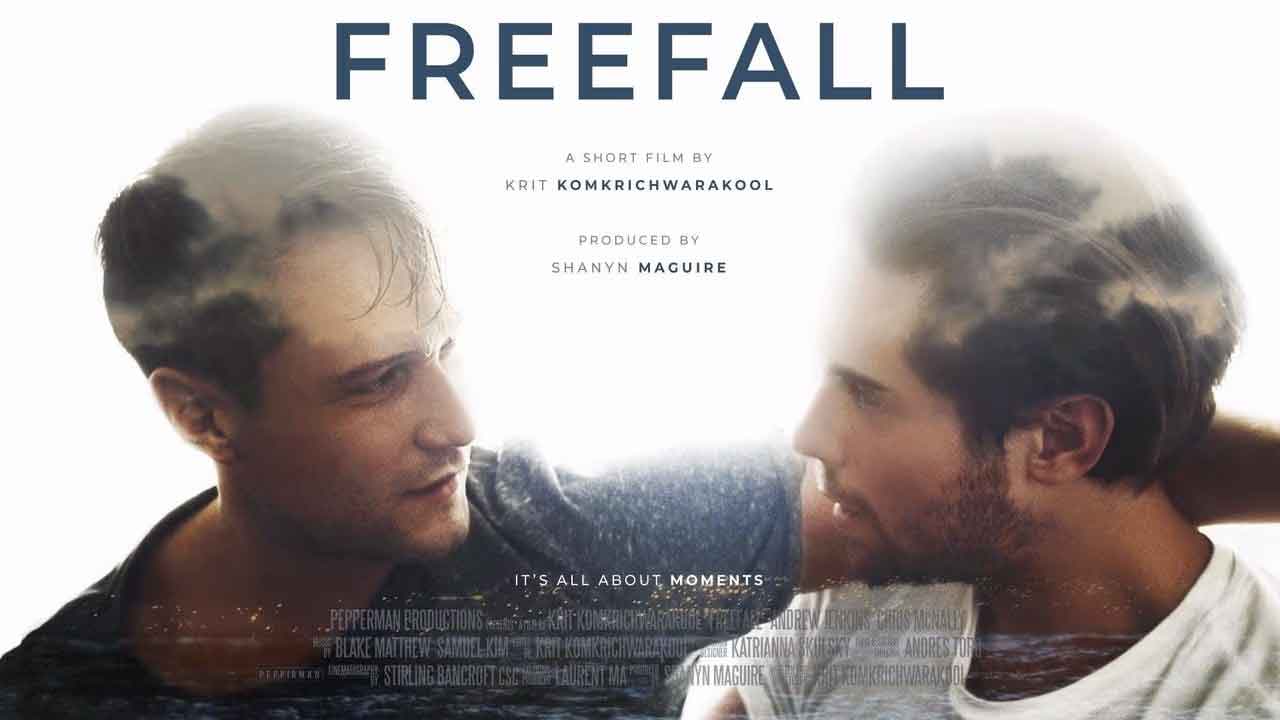



Freefall (2017) is a gay love story where ALS turns ordinary intimacy into a daily test of patience, pride, and fear. It’s tender, tense, and painfully human. The question isn’t “can they handle it”, but “can they still find each other inside it.”


Freefall (2017) is an award-winning LGBTQ+ short drama written and directed by Krit Komkrichwarakool.
Freefall (2017) starts in the least cinematic way possible – with a man on the floor. Not a dramatic collapse with violins. Just Ivan, down there, trying to “seduce” Lucas, like this is still a normal morning and not a new reality where gravity wins more often than pride.
Lucas rushes in, half worried, half annoyed, and you instantly get the rhythm of their relationship: love, caregiving, and sarcasm packed into the same sentence. Ivan cracks jokes to stay human. Lucas cuts food because “you’re too slow”. Ivan fires back with “Thanks, mom.” Lucas: “Please don’t call me that.” And that one line tells you everything – nobody wants their love to turn into a parent-child setup. But the illness doesn’t ask for permission.
A relationship with one extra roommate: ALS
What makes Freefall hit so hard is how quickly it shows that ALS is not just physical. It rearranges the power balance in the room. Ivan is losing control of his body, and that loss turns into a sharp kind of anger. Lucas is trying to hold things together, and that turns into pressure – the kind that makes a person shrink their own life without admitting it.
There’s a job interview Lucas didn’t go to. Ivan notices immediately. And the conversation is simple but brutal: Lucas can’t go back to work because he’s afraid to leave Ivan alone. Ivan pretends he’s fine, tries to push Lucas back into the world, and you can feel what’s underneath: “Don’t waste your life on me.”
And Lucas, being Lucas, responds with a joke. Ivan likes being on the floor anyway. Funny, yes. But it’s also the kind of humor people use when reality is too ugly to say out loud.
When intimacy becomes complicated
There’s a moment that looks like a normal couple thing – a massage, a touch, a little teasing. But Ivan pulls away: “There’s no point. It’s just gonna keep spreading.” That line isn’t just about symptoms. It’s about hope. About how hard it is to invest in a future when your body keeps taking it back.
Lucas tries to push through, tries to keep the physical closeness alive, and Ivan snaps: “You wouldn’t understand. You weren’t even there.” That’s the wound talking. The hospital night. The breakup. The moment Ivan remembers clearly even when other details blur. In this film, memory is not romantic. Memory is evidence.
And then the question arrives, like a knife that’s been sitting on the table the whole time: “Why are you still here?”
Ivan isn’t asking for a sweet answer. He’s asking because he’s terrified that what Lucas feels is pity. And Ivan would rather be alone than be someone’s charity project. That’s not pride. That’s survival. Because being loved out of pity feels like slowly disappearing while someone politely claps.
The skydiving metaphor, and why it actually works
They talk about repeating lives like repeating songs. Ivan is a musician, so this fits him like skin. Lucas says life is like skydiving – you only get that first jump once, then you free fall, then you land. Ivan laughs at him for being “deep today,” and it’s one of those rare scenes where you feel warmth again. Not fake warmth. The kind people find in small moments when they decide to be gentle, even if everything else is falling apart.
Lucas shares his “favorite moment”: seeing Ivan play piano, lonely and imperfect, and choosing to walk up and join him. They improvised a song, a ballad, and named it with that poetic line that keeps returning through the film: “She wrote the song to his dream. And he put the dream into the song.”
That becomes their secret language. Their reminder that love wasn’t built on caretaking. It was built on choosing each other in a moment when it would’ve been easier to walk away.
“I didn’t stay because you needed me”
The emotional peak isn’t shouting. It’s Lucas finally saying it clearly: he didn’t stay because Ivan needed him. He stayed because he needs Ivan. That matters. Because it puts Ivan back into the relationship as a person, not a patient.
And Ivan admits the fear he’s been trying to joke away: soon he might not be able to play music, or even feel Lucas. That fear isn’t dramatic. It’s quiet, and it lands like a weight in the stomach. The film doesn’t try to “solve” it. It doesn’t pretend love is a cure. It only offers something more believable: company.
Lucas says it might get worse. Ivan doesn’t deny it. But they hold onto one promise that feels realistic and heartbreaking at the same time: whatever it is, they will land together.
And then, because this is still them, Ivan tries to end the heavy talk with a kiss and a joke: he wants Lucas to shut up with the metaphors. He just needs “a little bit of help.” That line is the whole film in miniature – love, dignity, humor, and vulnerability, all in one breath.
Freefall is short, but it doesn’t feel small. It’s a gay love story where the most romantic thing isn’t a kiss. It’s staying in the room, telling the truth, and still reaching for each other even when fear is louder than anything else.