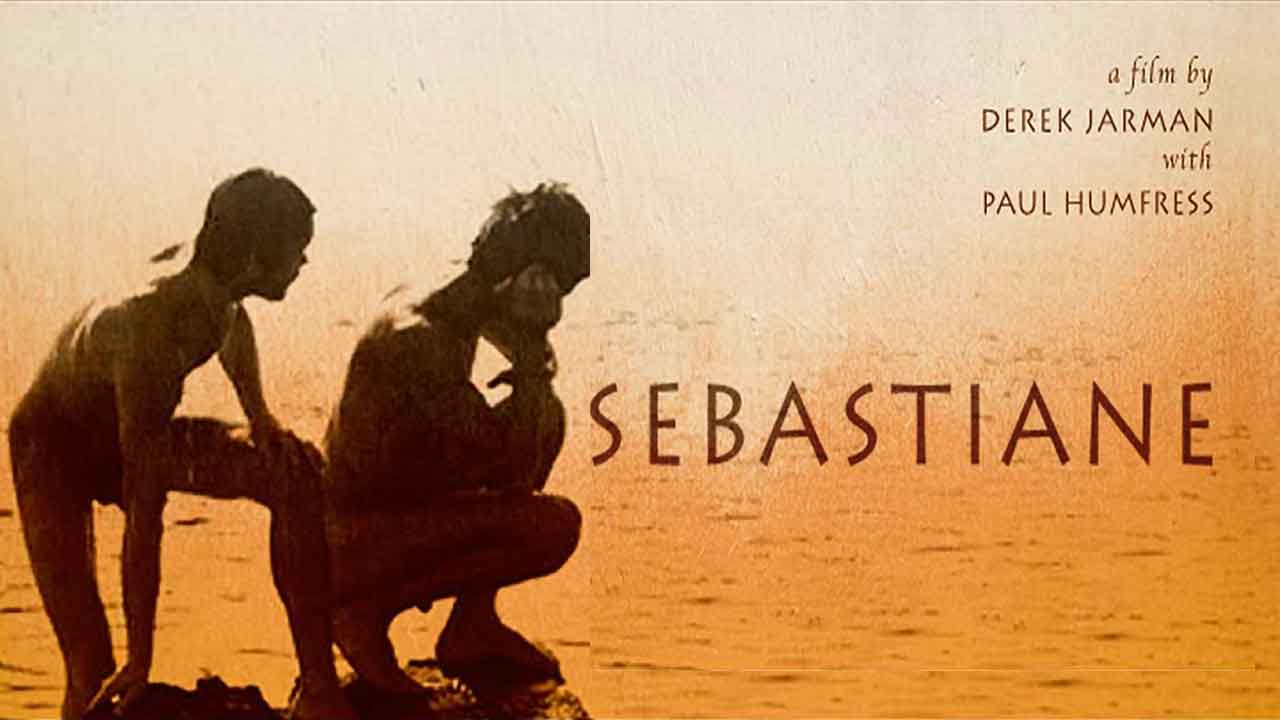



In Sebastiane, desire and devotion share the same body. In a forgotten Roman outpost, faith becomes rebellion, lust becomes power, and Saint Sebastian turns from beautiful icon into a living, bleeding question.


Sebastiane (1976) is one of those films that doesn’t just “adapt a legend” – it crawls inside it, sweats in it, and then dares you to decide what you actually believe. Derek Jarman and Paul Humfress take the familiar Saint Sebastian story and turn it into something raw, sensual, spiritual, funny, ugly, and strangely tender. It’s a historical film, sure, but it never feels like a museum tour. It feels like you got dropped into a dusty corner of the Roman world and now you have to breathe the same air as these men.
If you only know Sebastian as “the beautiful martyr with arrows” from Renaissance paintings, this film gives you the version with sand under his nails and bruises on his body. Jarman doesn’t polish him into a holy postcard. He makes him a young man who is adored, watched, wanted, and tested. And the miracle is that the movie can be filthy and poetic in the same minute, without blinking.
A Roman world that feels lived-in, not staged
The first thing that hits you is the texture. Sebastiane was made on a tiny budget, shot in Sardinia, and it shows in the best way. The costumes look worn, the camp looks genuinely miserable, the bodies look like bodies that live outside. This is not a glossy “swords and sandals” fantasy where everyone looks freshly oiled for a magazine cover. It’s closer to a documentary mood, like you’re watching bored soldiers inventing ways to survive the heat, the emptiness, and each other.
That rough realism is exactly why the film’s erotic energy feels different from the accidental homoerotic posing of mainstream epics. Here, the male gaze isn’t an accident. It’s the point. And yet it’s rarely “wink-wink.” It’s blunt, casual, part of the air. Men desire men, men joke about it, men threaten each other with it. The world doesn’t stop to explain itself.
Latin dialogue that actually changes the vibe
One of Jarman’s boldest moves is the spoken Latin. Not the clean classroom Latin, but a rough, street-level version that makes the soldiers feel like real people instead of marble statues reciting lines. With subtitles, you’re always aware you’re watching something constructed, but the sound of the language adds weight. It makes the camp feel like a sealed-off little universe with its own rules and its own cruelty.
And because the dialogue often swings between crude banter and sudden bursts of intensity, the film keeps shifting tone. You can go from locker-room nastiness to something that feels like a prayer, and it never feels forced. That tension is basically the movie’s heartbeat.
Severus: desire, power, and the slow build to violence
The central clash is not just “Rome versus Christianity.” It’s something more intimate and more dangerous: Severus versus Sebastiane. Severus is the captain who tries to control everything, including his own hunger. And of course that never works. His obsession with Sebastiane becomes a knot of lust, devotion, jealousy, and humiliation. He doesn’t only want Sebastiane – he wants to own the meaning of him.
What makes it unsettling (and weirdly compelling) is that the film doesn’t treat Severus as a simple villain. He’s frightening, yes, but also wounded by his own desire. There’s a sense that he cannot survive the contradiction between what he feels and what his world expects him to be. The result is a pressure-cooker dynamic where tenderness and brutality sit inches apart.
And here’s the trick Jarman pulls: some of the most sensual imagery feels like it belongs to Severus’s point of view. The camera lingers. It watches. It wants. So you, the viewer, get pulled into that uncomfortable space where beauty and possession start to blur.
Sebastiane’s faith: pure devotion or desperate reinvention?
The film’s spirituality is not clean or simple. Sebastiane’s Christianity feels real, but it also feels like something he builds inside himself because his world is collapsing. He’s betrayed, isolated, exiled into a wasteland, and his belief grows in that harsh environment like a fever that turns into clarity.
What’s fascinating is that the film lets doubt live right next to devotion. Is Sebastiane a “true” Christian in the strict sense, or is he stitching together something personal from older mythic roots and new religious longing? The movie never turns that into a cheap mystery. It treats faith as a human experience that can be sincere even when it’s confusing, even when it’s tangled with desire.
That’s why some scenes feel almost painfully intimate. Sebastiane speaks about love and beauty in a way that is both religious and erotic, like he can’t separate the two. His longing for God is not abstract. It’s physical, emotional, devotional, and sometimes delirious.
Water, bodies, and the strange tenderness of the camp
For a film set in a desert-like exile, Sebastiane has an almost obsessive relationship with water. Water becomes cleansing, sensual, dangerous, and symbolic. Bathing scenes and slow-motion moments can look like fantasy, but they also reveal something softer: connection, vulnerability, affection that doesn’t have to announce itself with modern labels.
And the film doesn’t only live in the big conflict. It also pays attention to everyday relationships between the soldiers: teasing, cruelty, friendship, flirtation, small alliances, and small betrayals. There’s a “men stuck together” energy that feels real. Sometimes it’s hilarious in a nasty way. Sometimes it’s genuinely warm. It’s a world where intimacy exists, even if it’s surrounded by aggression.
Brian Eno’s score and Jarman’s eye for living paintings
The music is minimalist and modern, and that’s exactly why it works. It creates distance from the expected “historical epic” vibe and makes the film feel timeless, like you’re not simply watching ancient history but watching a myth being reimagined in the present tense.
Visually, Jarman also plays with centuries of Saint Sebastian imagery without turning the film into a slideshow of references. You can feel the influence of Renaissance and Baroque compositions in certain poses and framings, but everything stays grounded in dirt, sweat, and real light. It’s art history filtered through a camera that refuses to sanitize anything.
Why it matters in queer cinema
Sebastiane is a landmark because it refuses the usual traps. It doesn’t treat queer desire as a hidden code or a punchline. It doesn’t reduce gay life to tragedy-as-punishment. It doesn’t build its whole identity around shame. Instead, it presents a world where male intimacy can exist as part of the social fabric, even while power and violence twist it into something terrifying.
And it’s also a film about how icons are made. Saint Sebastian became a long-standing gay symbol not just because of the arrows and the beauty, but because he represents suffering, endurance, eroticized pain, and the gaze that never stops watching him. Jarman takes that history seriously, and then makes you feel it in your gut, not just understand it intellectually.
In the end, Sebastiane is not an “easy recommend.” It’s experimental, confrontational, and sometimes deliberately uncomfortable. But if you give it your attention, it rewards you with something rare: a queer historical film that feels both ancient and modern, both sensual and brutal, both spiritual and political. It’s a film that looks at desire and asks, very quietly, what it costs to live honestly when the world would rather you stay silent.