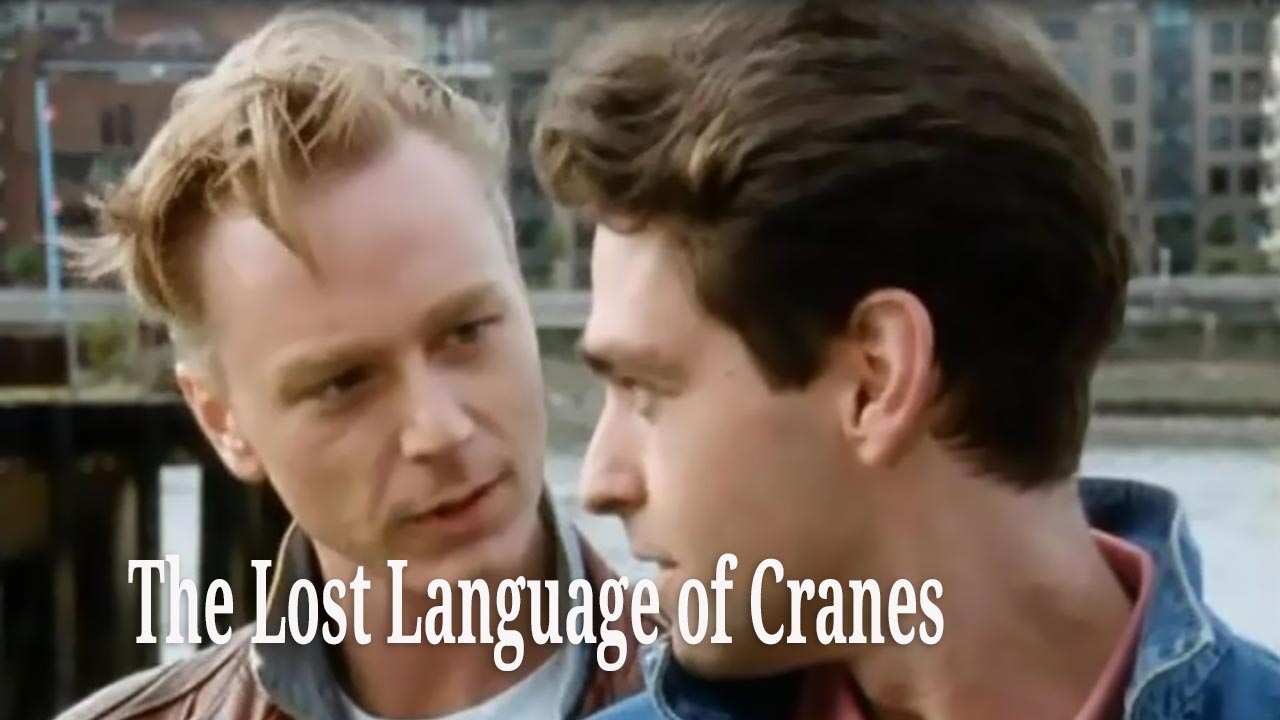




The Lost Language of Cranes (1991): When Coming Out Breaks More Than One Closet Door
Some family dinners are awkward because of politics, some because of dry turkey. In The Lost Language of Cranes, the awkwardness comes when a young man tells his middle-class parents that he is gay – and accidentally cracks open the silent, closeted life his father has been hiding for decades. This is not a loud film. It is quiet, bookish, very British, and then suddenly, without warning, it cuts right under the skin.
Philip, Eliot and the thin line between love and pressure
Our way into the story is Philip, played by Angus Macfadyen. Philip is not a tragic figure in the classic queer cinema sense. He has friends, a job, a flat, and a boyfriend. The real drama is not whether he will accept himself, but whether the people he loves can accept the fact that this is who he already is.
Philip is in a relationship with Eliot (Corey Parker), a man who seems charming, slightly distant, and very good at making Philip feel both loved and unsure at the same time. Their scenes together feel painfully real – there is a lot of affection, a lot of sex, a lot of small frictions that quietly grow into something larger. Philip wants something solid, something that can survive being seen in daylight, especially by his parents. Eliot wants freedom and space, and when things get too intense, his instinct is to pack a bag and move to another city. Or, in this case, another country.
The film is very honest about this kind of dynamic. Philip is emotionally attached, maybe a bit dependent, while Eliot keeps one foot outside the door. They are not villains or saints – just two men at different points in their emotional evolution, trying to pretend that this gap is not as big as it really is.
Owen and Rose – the parents who do not know their own story
Philip’s parents, Owen and Rose Benjamin (Brian Cox and Eileen Atkins), live in a world built on habits. Same flat for twenty years, same routines, same quiet evenings. On paper they are the respectable, slightly tired couple from a middle class London building. Underneath, things are rotting.
Rose is intelligent, sensitive and permanently worried. She feels that something is wrong in the marriage but cannot quite name it, so she focuses on practical things: money, moving to a new place, the future. Owen, on the other hand, lives a double life that the film reveals with brutal calm. While his wife counts the months until they have to move out, he disappears every Sunday to gay porn cinemas and cruising spaces, desperate for physical contact and equally desperate not to leave any trace.
When Philip finally gathers courage and comes out to them, the scene is almost painful to watch. He is sincere, prepared, even a bit didactic. He talks about secrets, about how everyone at work already knows, how he is tired of hiding. Rose reacts with confusion and defensive politeness. She wants to be supportive, but every sentence comes out twisted. Owen says almost nothing. He sits in silence, and you can practically hear his inner life exploding off screen.
The other queer family as a mirror
To make things even more interesting, the film introduces Derek and Geoffrey, an older gay couple who once took care of Eliot. They are witty, warm and fully out. They argue about books, tease each other, cook, and function as a living proof that queer life can be not only possible, but ordinary and stable.
Philip and Eliot spend time with them, and in those scenes you feel a completely different energy. Here, being gay is not a crisis, just a fact. The contrast between this household and the Benjamin family is painful and intentional. On one side, a home built on honesty. On the other, a home built on thirty years of silence.
The boy and the cranes – a metaphor that actually works
The film uses one central metaphor that gives it its title. There is a story about a neglected little boy who lives near a construction site and starts imitating the movement of the cranes outside his window. He raises his arms, bends, twists and makes strange sounds, basically inventing his own private language – a body-language of survival in an environment that does not speak to him.
This image sits quietly in the background until you realise what the film is doing. Every character has their own “crane language”. Philip learns to split himself into the son his parents want to see and the man he really is. Owen develops an entire secret choreography of lies, routines and coded behaviour to hide his sexuality. Rose invents a language of denial, where everything is fine as long as it is not named. Nobody is speaking honestly, but everybody is communicating something, somehow.
Quiet brutality instead of melodrama
One of the strengths of The Lost Language of Cranes is that it never slips into cheap melodrama. There are big emotions here – betrayal, shame, desire, fear of growing old alone – but they are played in small rooms, with quiet voices. When Owen finally breaks down, it is not a grand theatrical scene. It is a man who realises, probably for the first time in his life, that his son’s courage has exposed his own lifelong cowardice.
The film does not excuse Owen, but it does not crucify him either. It shows the cost of living a lie in a hostile time and place, and how that poison slowly spreads to everyone around. It is hard not to feel sympathy and anger at the same time. You understand the weight of the closet, and still cannot ignore the damage it does.
Why the film still matters
Even though the film is from the early nineties, a lot of it feels uncomfortably current. The details have changed – we have dating apps instead of cruising cinemas, and more visible queer representation – but the basic emotional map is still here. Children who are afraid to tell their parents who they are. Parents who would rather not know. Older queer people who spent half a lifetime pretending and now do not know how to start over.
The Lost Language of Cranes is not a “feel good” film, but it is strangely comforting. It says, very clearly, that there is no neutral position. Silence is not neutral. Not asking questions is not neutral. A family can look calm on the surface and still be slowly dying underneath because nobody dares to speak their true language.
If you are watching it for the first time, expect a slow, literate drama with a lot of talking, some beautifully written confrontations and a few moments that might unexpectedly punch you in the chest. If you are watching it as someone who has ever come out, or thought about it, you might also feel a dangerous recognition in Owen – the reminder of what happens if you never do.
It is a film about fathers and sons, about the languages we invent to survive, and about what it costs when we finally decide to speak plainly. Not flashy, not perfect, but deeply human which is probably why it stays in your head long after the credits.