


Two men walk into the ER with a head injury and a half-relationship. By morning, the bruises are not the worst part.


Some short films feel like a sketch. Bumping Heads feels like you accidentally opened someone’s diary in the ER waiting room and now you can’t unsee it.
On paper it sounds almost cute: two guys, Craig and Gary, stumble into each other’s orbit, literally bump heads, laugh, exchange numbers, and build a messy little bond. In reality, the movie is a tight, talky pressure cooker where every joke is a defense mechanism and every “we’re just friends” lands like a slap.
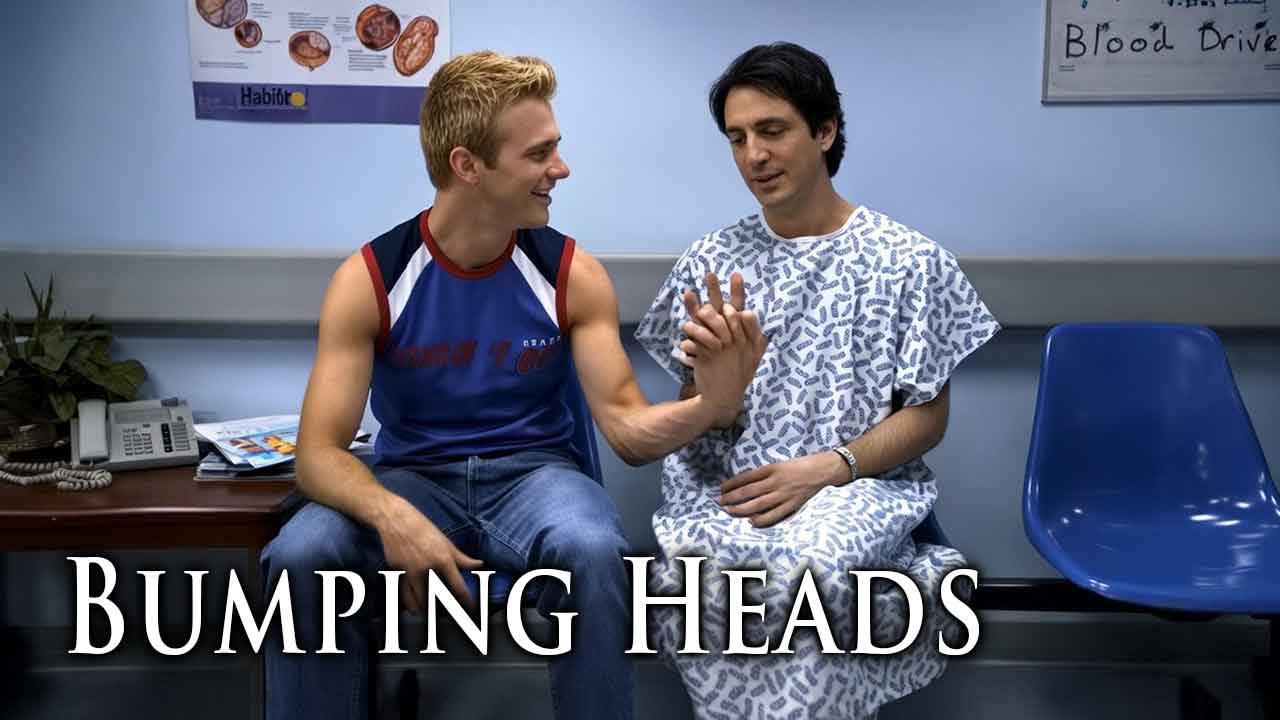
Most of it unfolds in one location, the emergency room at St. Vincent’s, after Craig gets into a fight in a club. But don’t let the “hospital night” setup fool you. This isn’t a medical drama. It’s a relationship autopsy performed under fluorescent lighting.
A one-night film that feels like a whole relationship
Craig is 35 and feeling it. Not in a “midlife crisis, buy a convertible” way, but in that quieter, meaner way: the creeping suspicion that you’ve become invisible in rooms where you used to be noticed. Gary is younger, pretty, social, and slippery. He’s the type who can turn a bad night into a funny story, then vanish when the feelings show up with their suitcase.
The film does something smart right away: it doesn’t try to make either of them a villain. Craig is not “the bitter older guy,” even if he flirts with bitterness. Gary is not “the heartless tease,” even if he plays with emotional boundaries like they’re optional. They are both believable because they are both inconsistent. That’s the point.
Craig vs Gary: the age gap without the cliché
Age gap stories in queer cinema often go for easy lessons: the older man is predatory, the younger man is naive, cue moral panic, roll credits. Bumping Heads avoids that. The tension here isn’t “Is this wrong?” The tension is “What are we allowed to want from each other?”
Craig wants clarity. Gary wants comfort without commitment. Craig wants to be chosen. Gary wants to be adored, but also wants a back door he can slip through if the room gets too real. And once you understand that dynamic, every scene starts to sting a little more.
The hospital as confession booth
The ER setting is perfect because it forces proximity. You can’t dramatically storm out when you’re waiting for X-rays. You can’t flirt your way out of accountability when you’re wearing a paper gown. The film uses that trapped energy well, bouncing between sarcasm, anger, tenderness, and those sudden soft moments that feel like accidents.
There’s a running gag about Craig being “dramatic,” and yes, it’s funny. But the joke has teeth. When someone calls you dramatic, what they often mean is: “Your feelings are inconvenient.” Craig’s “drama” is basically his emotional honesty leaking out in a world that rewards coolness, especially in nightlife spaces.
And Gary? Gary is cool. Too cool. The kind of cool that makes you feel crazy for wanting normal things like definitions, honesty, and not being surprised by a boyfriend who lives 3,000 miles away.
The real fight is not the one in the club
The club incident is almost a decoy. The real conflict is what gets revealed around it: Gary has a long-term boyfriend in Los Angeles, and Craig finds out in the worst possible way, mid-party, mid-humiliation. It’s the kind of reveal that makes you replay every earlier conversation like a detective trying to solve your own heartbreak.
Craig’s anger makes sense. Not because Gary “owes” him a relationship, but because Gary has been building intimacy while withholding context. That’s not harmless. That’s emotional negligence. The film doesn’t preach that line, but it shows it clearly.
That kiss scene
Eventually, there’s a moment that’s both inevitable and painful: Craig tries to kiss Gary. It’s awkward, it’s messy, and it detonates the fragile “we’re fine” fantasy instantly. Gary snaps back into his boundary speech, Craig collapses into laughter that isn’t really laughter, and you can almost hear something inside him crack.
This is where the film earns its emotional credibility. It doesn’t romanticize rejection. It doesn’t turn it into a clean life lesson. It just lets it be what it is: humiliating, confusing, and weirdly intimate because they’re still standing there together in the aftermath.
McDonald’s, or: the cruelest epilogue
After the hospital, they end up at McDonald’s. And if you’ve ever been awake at 4 a.m. with someone you love who doesn’t love you back, you already know what kind of scene this is going to be.
Gary orders Craig the exact meal he wants without asking. That tiny detail is devastating. It’s tenderness. It’s familiarity. It’s “I know you.” And then, when a cashier casually checks whether they’re together, Craig says no. Not with anger. With exhaustion. With the kind of quiet defeat that doesn’t need music.
It’s a small moment that captures a big truth: sometimes the person who understands you best is still not willing to claim you.
Why it still lands
What makes Bumping Heads work is its honesty about an experience queer people rarely get to see portrayed without polish: the half-relationship. The intense friendship that acts like a romance until romance shows up and ruins the vibe. The intimacy with plausible deniability. The “I like you, but only as a friend” that somehow includes hand-holding in an ER at 3:30 a.m.
There’s also a quiet educational layer here if you’re paying attention. This film sits in that early 2000s queer short tradition where nightlife is both freedom and trap. Clubs are where you find your people, but also where you learn the unspoken rules: youth is currency, coolness is armor, and wanting too much can get you labeled “dramatic” fast.
Is it perfect? No. Some of the dialogue leans theatrical, and the structure is essentially one long emotional argument with flashbacks. But that’s also why it feels real. Most heartbreak isn’t cinematic. It’s repetitive. It’s the same point argued twelve different ways until someone finally admits what they can’t give.
Bumping Heads is not a comfort watch. It’s a “text your friend after” watch. The kind of short film that leaves you thinking about your own almost-relationships, the ones that felt huge in the moment and then evaporated in daylight. And honestly, that’s a compliment.