




There is nothing wrong with a wild night of sex, a little adventure, or enjoying someone's body without promising them your heart. But what happens when the party is over, everyone has gone home, and you realize that all you really wanted was someone to stay? Sergio Tovar Velarde's The Divine Tragedy takes that question, wraps it in outrageous gay humor, explicit sexuality, family drama, and a surprising amount of tenderness, and gives us a story that is far more human than its wildest scenes might suggest.

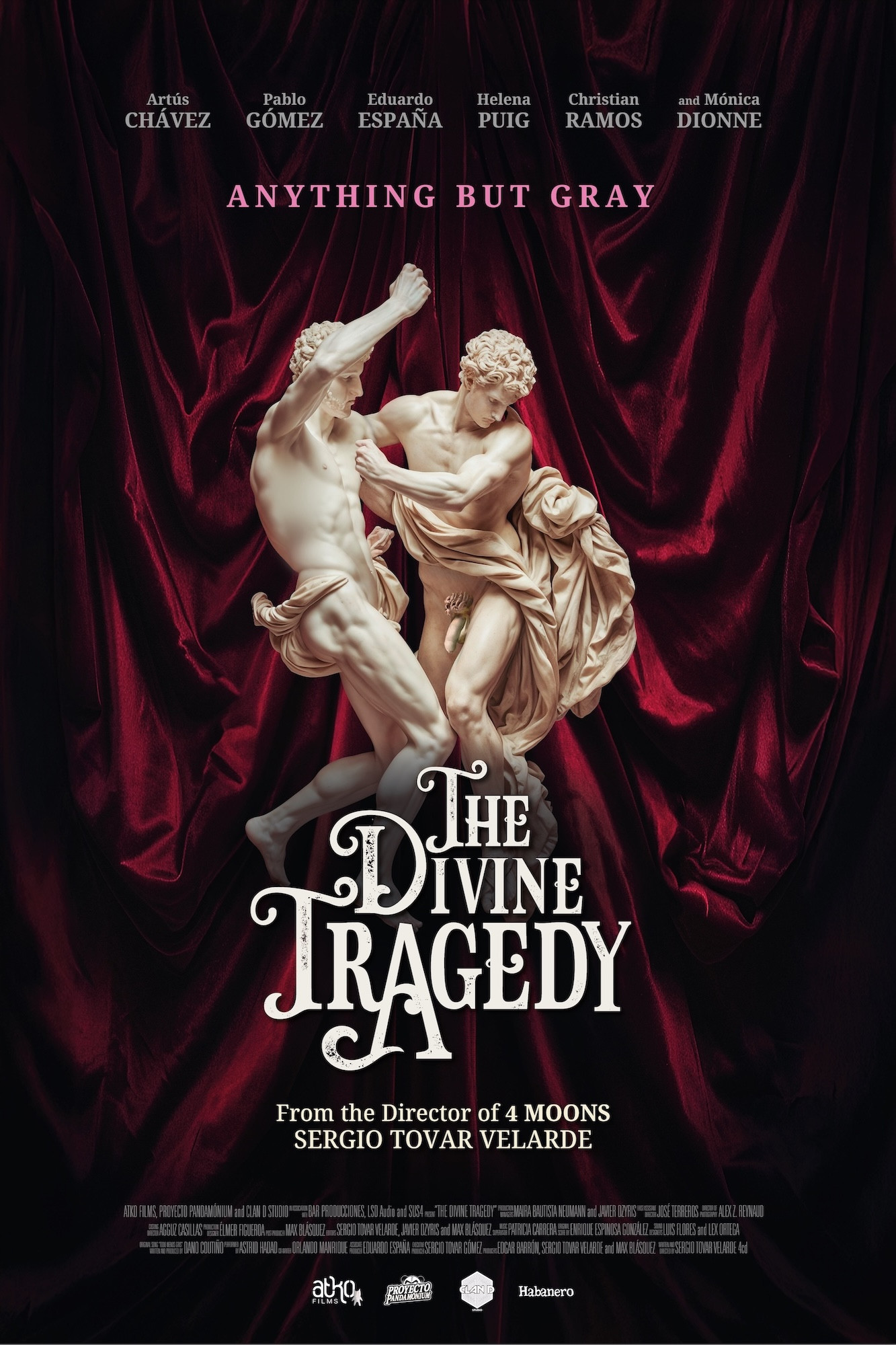
Imagine spending almost twenty-five years with the same man. You have a beautiful home, money, expensive clothes, good friends, and a comfortable life. You are planning another anniversary celebration, perhaps even a romantic cruise. Everything seems to be in its proper place.
And then your husband tells you he wants a divorce.
Not another argument. Not a little break to think things over. A divorce.
That is exactly what happens to Cristián (Artús Chávez), a former telenovela actor who gave up his career to build a life with his wealthy husband, Carlos. Within days, he discovers that Carlos has blocked his credit cards, hired a lawyer, and begun arranging a future without him.
Cristián is devastated. Not only because he has lost his husband, but because he has almost forgotten how to live without him.
With nowhere else to go, he moves into an apartment shared with his younger half-brother, Roy (Pablo Gómez).
And that is where the real trouble begins.
Two Brothers, Two Very Different Worlds
Roy is thirty, works as a barber, and enjoys a lifestyle that would probably give his older brother a nervous breakdown. Sex, parties, casual encounters, drugs, and a constantly changing collection of friends and lovers are all part of his everyday life.
Cristián, meanwhile, likes order, cleanliness, expensive skincare products, carefully arranged belongings, and a predictable routine. He is the kind of man who worries about where to put his towels. Roy is more interested in who might be taking those towels off.
Putting them together is a wonderful recipe for disaster.
The arguments begin almost immediately. Cristián wants to reorganize the apartment, Roy wants him to leave everything alone, and neither seems particularly interested in understanding the other.
They criticize each other's habits, make fun of each other's sexual choices, and behave like two people who have absolutely nothing in common.
But here's the funny thing. The more time they spend together, the clearer it becomes that they are not nearly as different as they believe.
Cristián spent years holding on to a relationship that eventually fell apart. Roy runs in the opposite direction whenever a relationship threatens to become serious.
One cannot accept that love has ended. The other cannot accept that love might be beginning.
And both are terrified of being alone.
Sex, Fetishes, and the Morning After
Let's get something straight. The Divine Tragedy is not shy about sex.
There is plenty of it, and some scenes are remarkably explicit. The film explores different gay fetishes, sexual habits, casual encounters, and the kind of nightlife that rarely finds its way into mainstream romantic comedies.
Some situations are genuinely funny. Others are erotic, uncomfortable, or emotionally revealing. Not every sexual encounter is meant to be a joke, and that distinction matters.
This is definitely a film for adults, and probably not something you want playing on your television when unexpected visitors walk into the room.
Yet the sex is not simply there to shock us.
Look at Roy. Finding someone to sleep with is rarely a problem for him. He knows how to flirt, how to attract men, and how to enjoy himself. But when Esteban, a handsome young neighbor, begins to offer him something more than another night together, Roy suddenly becomes much less confident.
He can handle sex. What frightens him is the possibility that someone might actually get to know him.
Anyone familiar with this side of gay nightlife may recognize the feeling. The party has been wild, the sex has been great, and the night seemed endless. Then morning arrives. The music has stopped, the lights are coming on, and the room is full of exhausted, spent bodies.
Some men are sleeping. Others are recovering from the night before. Perhaps you cannot even remember everyone's name.
And somewhere in the middle of all that, a thought appears that you would rather not have:
After all those bodies, all that sex, and all that excitement, why the hell do I still feel so alone?
That is the question Roy keeps avoiding.
Another party, another man, another sexual adventure. All perfectly fine if that is what he truly wants. But none of those encounters can guarantee the affection and companionship he seems to be searching for.
And when someone offers him a chance to have exactly that, he does not quite know what to do with it.
Rosita, the Most Unusual Fortune-Teller You Will Ever Meet
Among the film's wonderfully eccentric characters, Rosita (Helena Puig) deserves special attention.
She has an extraordinary gift. She can supposedly see people's futures while performing oral sex on them.
Yes, you read that correctly.
Forget crystal balls, tarot cards, and mysterious candles. Rosita has developed a considerably more intimate method of predicting the future.
It sounds ridiculous, and it is. But this is where Velarde's sense of humor becomes particularly interesting. Because Rosita, despite her unusual profession, often understands the people around her better than they understand themselves.
When Cristián desperately wants to know how to win Carlos back, Rosita tells him something he does not particularly want to hear:
"Cristián, you need to remember the last version of yourself you truly liked."
In other words, stop worrying about how to make Carlos love you again. First, remember who you were before you became someone else's husband.
And when Roy comes to her with his own problems, she is even more direct:
"You like everyone because you don't really like anyone."
That is quite a thing to tell a man who seems to have an endless appetite for sex.
But Rosita has understood something important. Roy is not necessarily enjoying all those encounters as much as he wants everyone to believe. Sometimes he is simply trying to fill an emptiness that another body cannot fill.
Her advice is wonderfully simple:
"First, you have to find yourself."
And then:
"Roy, stop wasting yourself."
There you have it. A woman who claims to predict the future through oral sex turns out to be one of the wisest people in the entire film.
Perhaps she does not need supernatural powers at all. Perhaps she simply knows how to recognize a lonely person.
Maybe the Man You Ignored Was Worth Knowing
There is another thought that kept coming back to me while considering Cristián and Roy.
How many people have I pushed away simply because I thought they were too different from me?
Think about those two brothers. One likes stability, the other loves chaos. One believes in lasting relationships, the other runs from them. They disagree about almost everything, from sex to housekeeping.
Yet when life forces them to share an apartment, they gradually discover that beneath all those differences they carry remarkably similar fears and desires.
Both want affection. Both want to be understood. Both are afraid of rejection.
It makes you wonder how often we dismiss someone before giving them a real chance.
Perhaps he dresses differently. Perhaps his sexual habits seem strange to us. Perhaps he is older, younger, quieter, louder, or simply lives a life we do not understand.
And so we decide there is nothing worth discovering.
But what if we are wrong?
And since this is Orvel, forgive me for being explicit, but sometimes I think the question is as simple as this:
You sucked my cock beautifully, but you haven't the faintest idea who I am. You never bothered to find out. Who knows? Maybe I'm exactly the man you'd enjoy having coffee with tomorrow morning.
There is no shame in enjoying sex simply for pleasure. Not every encounter needs to become a love story, and not everyone is looking for a permanent relationship.
But if you are looking for someone to share your life with, perhaps it is worth spending a few minutes discovering who is actually lying beside you.
Sometimes we are so busy searching for the next interesting man that we overlook the one who is already there.
More Than an Outrageous Gay Comedy
What makes The Divine Tragedy worth watching is not simply its raw portrayal of gay sexuality or its willingness to laugh at subjects that other films prefer to avoid.
It is what happens when the laughter fades.
Cristián begins to realize that his life cannot revolve forever around the husband who left him. Roy discovers that being free to sleep with almost anyone does not necessarily mean being free from loneliness.
And the two brothers, who once seemed incapable of understanding each other, slowly learn that their differences do not prevent them from sharing something genuinely important.
Velarde tells this story through outrageous situations, sexual adventures, absurd humor, and moments of unexpected tenderness. The film can be crude and deliberately excessive, but it does not ask us to judge its characters for their desires.
They make mistakes. They hurt people. They hurt themselves. Sometimes they are ridiculous, sometimes selfish, and sometimes surprisingly kind.
In other words, they are human.
And perhaps that is the most appealing thing about The Divine Tragedy. It does not ask its characters to become perfect. It allows them to recognize their mistakes, reconsider their choices, and discover that they might still have something to offer one another.
After all the sex, the parties, the arguments, and the laughter, the film leaves us with a rather ordinary thought, one that is easy to forget in the middle of an extraordinary night:
Sometimes finding love has less to do with meeting another man and more to do with finally taking the time to know the one standing right in front of you.
And who knows? Maybe he would even stay for coffee.