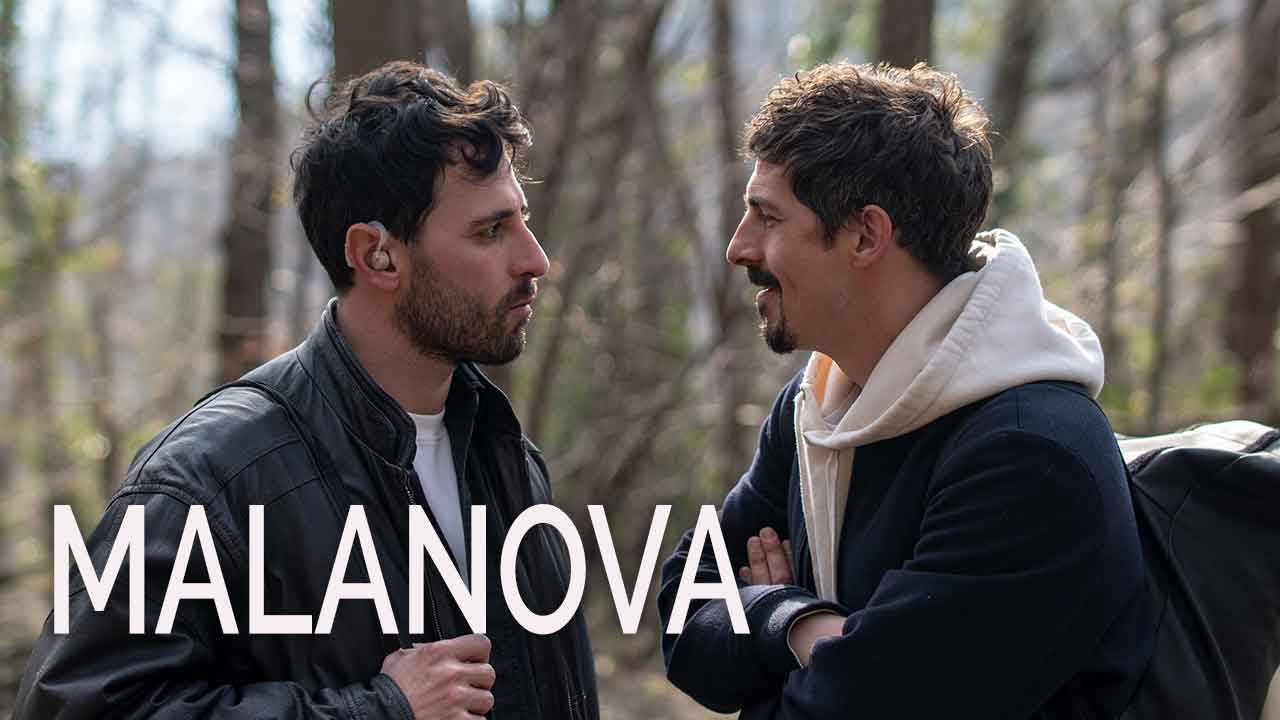





Malanova (2024) starts like a little romantic postcard you would send to yourself when you still believe love is mostly about flights, plans, and saying cheesy things with a straight face. “What do you think of Lisbon?” “It’s beautiful.” “Just like you.” Six months together, a small gift (a book by Matteo’s favorite writer), and that soft couple-energy where everything feels possible.
And then the film does the thing real life does: it interrupts the vibe without asking permission.
Matteo gets his diagnosis. HIV positive. The script does not milk it with melodrama, which is exactly why it lands. It lands because the next scenes are not about “big tears”, they’re about behavior: fatigue, silence, food that suddenly tastes like cardboard, and two people trying to keep their relationship standing while the ground under them quietly shifts.
A very modern conversation, with very old fear inside it
The medical part is presented in a refreshingly direct way. The doctor talks like someone who has had this conversation a thousand times and wants Matteo to survive it with his sanity intact: therapy starts with one tablet per day, later possibly injections every two months, viral load aimed down to zero. It’s calm, practical, and it underlines the point without preaching: medicine has moved forward.
But the emotional software is still running an older version.
Riccardo knows, and he tries to be present, but presence is not the same thing as courage. Riccardo’s fear comes out in a way that’s painfully believable: he refuses to get tested. Not because he hates Matteo, but because he is terrified of what the result might do to their life, to his body, to their future plans, to the relationship itself. The clinic moment where Riccardo says he will wait outside while Matteo goes in is small, but it screams. You can almost feel how avoidance pretends to be “care”, while actually feeding panic.
This is where Malanova becomes more than a “message film.” It is not telling you that stigma exists. It is showing you how stigma acts like a ghost that makes people stall, avoid, delay, and call it caution while it quietly eats the time they need.
Enzo: the bridge between two eras
Then Enzo shows up, Matteo’s uncle, and the film suddenly gains another dimension. Enzo is older, rough around the edges, with arthritis and that tired humor people use when life has hit them a few times and they are still standing anyway. He brings food, beer, stories, and most importantly: memory.
Enzo talks about “back in my day” without turning it into a history lesson. He mentions how much worse things were, and the damage from the “cursed pill” that harmed people as much as the virus itself. Then he does the key thing the film needs: he draws a line between then and now. Today, he says, one medicine is enough, minimal side effects, keep moving forward.
And he tells Matteo the sentence that should be printed on a poster for this film: with therapy, you no longer have to be afraid of infecting someone. It is simple, direct, and you can feel Matteo’s brain fighting it, like fear does not want to give up its job.
Enzo also brings a love story into the room. A story about Paul, about waiting, about weeks of absence, about a wrong diagnosis, about staying together until death, and about ending up alone because family abandons you. This is not there to compete with Matteo and Riccardo’s plot. It is there to give it weight. To remind you that for older queer generations, the trauma is not theoretical.
The fight scene is not about pills, it’s about control
Eventually the tension snaps, and the film gets loud, messy, and human. Riccardo asks the obvious question: “Why aren’t you taking the pills?” Matteo shuts down. Riccardo pushes harder, which is what scared people do when they think pressure can fix panic. Matteo explodes. And suddenly the dialogue becomes a loop: “Leave me alone!” over and over, like a siren going off inside a relationship.
This sequence hits because it doesn’t pretend love automatically makes you wise. Love can make you clingy. Love can make you controlling. Love can make you say the wrong thing with the right intention, which is still the wrong thing.
Matteo even floats the nuclear option: maybe they should break up. Not because he wants to, but because shame loves that move. Shame always suggests the same solution: remove yourself before you “ruin” someone else’s life.
A valley legend, a collapsed road, and an ending that goes for the throat
One of my favorite touches is the weird little valley legend about demons feeding on the souls of “unclean people who are afraid.” It’s basically the film saying, in story form: fear is the demon. Fear is what keeps people stuck. Fear is what makes them “unclean” in their own heads.
Then the road literally collapses after heavy rain. No other way out. The metaphor is not subtle, but it works. Because that’s what the diagnosis does to them: it blocks the easy exit and forces them into the uncomfortable route, the one where you actually have to talk, decide, act.
And when the film moves toward its ending, it stops trying to be “plotty” and becomes a statement about living. Memories fade. Guilt and worry are called the most useless feelings in life. Fear is acknowledged, faced, and then left behind. Together is stronger. Start from where you are, with what you have. Go now, before dark.
That final stretch is not subtle either, but again, it earns it. Because Malanova is not trying to be a twisty drama. It’s trying to be the kind of film that younger viewers can watch and walk away with one very clear idea: HIV is not the end of intimacy. Fear is. And fear is the one thing you actually have some power over, if you stop negotiating with it and start moving.
In 73 minutes, it gives you a love story, a panic story, and a small lesson in emotional adulthood. Not perfect, not polished, but honest. And sometimes honesty is the bravest romance of all.