

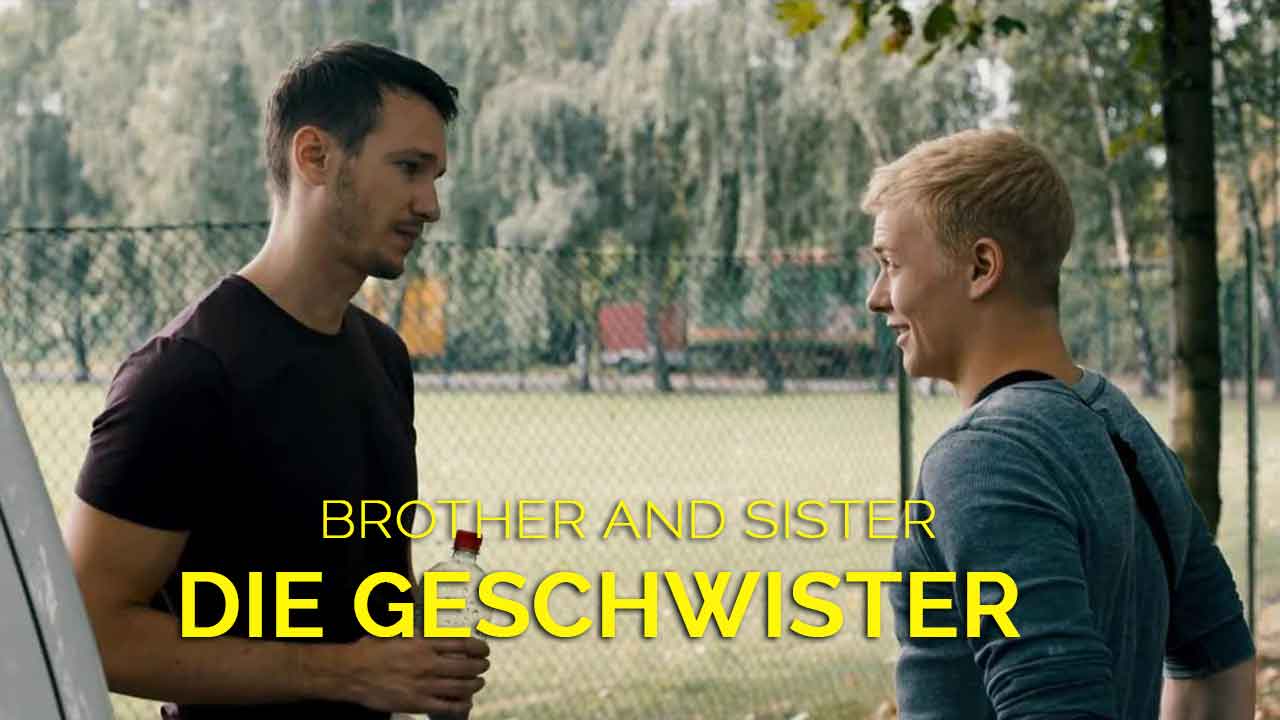



If you have ever lived in a rented flat, you know that strange feeling when you hold the key in your hand but nothing really belongs to you. In Die Geschwister (Brother and Sister) everything turns around exactly that – keys, doors, and the question of who actually gets to call a place home. One apartment in Berlin becomes a temporary shelter for three people who have slipped out of the system in different ways and cling to each other as if they are the last ones left.
Thies is our quiet guide through the story. He works as a property manager, the kind of man who unlocks and locks other people’s lives. He checks basements and stairwells, deals with burst pipes and angry tenants, shuffles papers in glass offices and pretends it is all under control. On the surface he is calm and tidy, but underneath you feel someone who would probably fall apart without routine. When he meets Bruno and Sonja, two strangers without papers, something rare happens in adult life – suddenly he cares deeply about new people.
Bruno and Sonja present themselves as brother and sister. They have no proper contracts, no official income, no magic combination of documents that landlords and agencies want to see. What they do have is each other, a handful of lies and a lot of improvisation just to avoid being pushed out of the country. They move through Berlin like ghosts: visible enough to clean, work and pay, but invisible when the state starts asking questions.
By the book, Thies should tell them the usual line: sorry, you do not qualify, next please. Instead, he breaks his own rules. He secretly gives them an empty flat, off the record. No contract, no formal permission, just a key and a quiet “here, try to make this yours for a while”. At that moment he stops being only the man of the system and becomes part of their fragile little conspiracy.
From there the film shifts into a story of tiny movements. Who leaves food in the kitchen. Who shows up unannounced. Who lingers a little too long on the sofa. Bruno and Thies start circling each other in that slow way where you are not sure if it is friendship, protection or something much more dangerous for everyone involved.
Bruno is the kind of character who gets under your skin without a big entrance. He is not loud, not aggressive, not a drama queen. There is just this mix of charm, sadness and small jokes that makes it very easy to see why someone like Thies would fall for him. At first it plays like a makeshift family: Thies as the responsible adult, Bruno and Sonja as the two who need a roof and a bit of structure. But the air between Bruno and Thies quickly turns warmer than that.
The attraction between them does not explode, it hums quietly in the background. A touch on the shoulder that lasts a second too long. A glance that keeps coming back. A joke that lands a little too close to flirting. Eventually the film stops pretending and lets them end up in bed together, but even that is not shot as scandal or spectacle. It feels like the natural continuation of a closeness that was already there, just waiting for bodies to catch up.
Except there is a third person in this equation, and Sonja is not a piece of furniture in the background. Her history with Bruno goes much deeper than the “sister” label they sell to landlords. She once worked in his parents’ house, half nanny and half invisible servant, until Bruno’s mother got jealous and threw her out. From that moment on, Bruno and Sonja became their own tiny unit, a private family built out of rejection. He decided he would protect her. She decided nobody would pull them apart again.
This is where the film becomes quietly brutal. There are no big speeches and no scenes where someone dramatically announces who they are. Instead we watch three different fears circling in the same space.
Thies is afraid of being alone. He knows Bruno and Sonja can vanish overnight. Deep down he feels that this might be his last chance to anchor his life to something warmer than rent increases and maintenance reports. Every visit, every shared cigarette, every night on the sofa is an investment he cannot admit he is making.
Bruno is afraid of losing Sonja. She is not just a friend or ex-employee of his parents. She is his entire childhood, his rebellion against his family, his proof that he is not completely useless. Letting go of her would mean admitting that the boy who once tried to save her has grown up and maybe failed.
Sonja is afraid of being abandoned one more time. By employers, by men, by the state. She does not trust contracts, pretty promises or official smiles. What she trusts is who shows up when things get ugly. From that angle, Thies is not only the nice landlord, he is also a potential threat to the balance she has with Bruno.
Of course, the outside world does not disappear just because three people try to build a nest in one flat. There are activist groups who want someone like Thies to help them place more undocumented tenants. There are new owners and renovation plans. There is the constant risk that someone will check a list, knock on a door and notice that the “empty” apartment is very much alive.
Bruno and Sonja live with that tension every day. Their answer is not a heroic stand, but something much more believable: they leave. Not with fireworks, not with a big scene. They are simply gone. They choose survival over romance, movement over roots, safety over the promise that this time will finally be different.
Thies is left in the hallway with his keys and his feelings, painfully aware that he has once again become what he was at the beginning – the man who opens doors for others and goes home alone. The difference is that now he knows exactly what he had for a moment and what he lost.
Die Geschwister is absolutely a queer film, just not the loud kind. Bruno’s desire for men is never wrapped in speeches or rainbow-coloured declarations, it simply exists, side by side with his intense bond to Sonja. Thies is not a tragic stereotype, but a recognisable gay man trying to be a good citizen and ending up tangled in the very rules he is paid to enforce. Sonja is not the jealous straight woman who ruins everything, but someone who knows that love and dependence can look dangerously similar when you are always one step away from being thrown out.
The film is not there to teach you a lesson about identity. Instead, it watches three people as they try to build a tiny, improvised family inside a system that prefers neat files to messy lives. If you want big plot twists and courtroom speeches, you will be disappointed. If you are curious about those quiet, in-between spaces where affection, fear and need overlap, you will probably stay until the end.
When the credits roll, Die Geschwister leaves you with the feeling of standing in an empty flat after everyone has moved out. The walls still remember where the furniture stood, there are marks where pictures used to hang, and maybe one forgotten glass in the sink. You know that something tender, complicated and temporary happened here. You also know that, in another part of the city, those same people are already starting over – with new doors, new keys and the same old need to belong somewhere, to someone, if only for a while.