



A boy thinks he can flirt with danger and still remain untouched, but Ernesto learns fast that desire has its own class, its own language, and its own price. Michele Placido gives the film its pulse, turning sweat, strength, and rough tenderness into something Ernesto can neither fully control nor forget.


I finally sat down with Ernesto, and what hit me first was not the scandal of it, not even the sexuality, but the texture. This film feels lived in. It smells like dust, sweat, soap, tobacco, cramped rooms, family expectations, and that strange panic of being young and realizing your body has already started making decisions before your mind has caught up.
At the center of it is Ernesto, a boy who looks polished enough to pass for someone already formed. He has the posture, the manners, the clothes, the slightly aloof way of speaking that says, “I know who I am.” The truth is much messier. Ernesto is still very much a boy, still trying on identities the way other people try on jackets. He plays the gentleman, the future intellectual, the dutiful son, the budding socialist, the young man who should probably be interested in girls. Underneath all that, he is just fascinated by life when it stops behaving politely.
And then Michele Placido walks into the film like a challenge.
Placido’s laborer is not refined, not soft, not decorative, and certainly not there to flatter Ernesto’s fantasy of himself. He is all body, all work, all immediacy. He belongs to the warehouse, to wages, to effort, to the world of men who carry things, sweat through shirts, and don’t have the luxury of turning every emotion into a philosophical problem. That is exactly why he becomes irresistible. Ernesto does not simply desire him as a man. He desires what he represents: physical certainty, adult experience, class difference, raw masculine force, and a kind of honesty that cannot be ironed flat.
A warehouse full of more than cargo
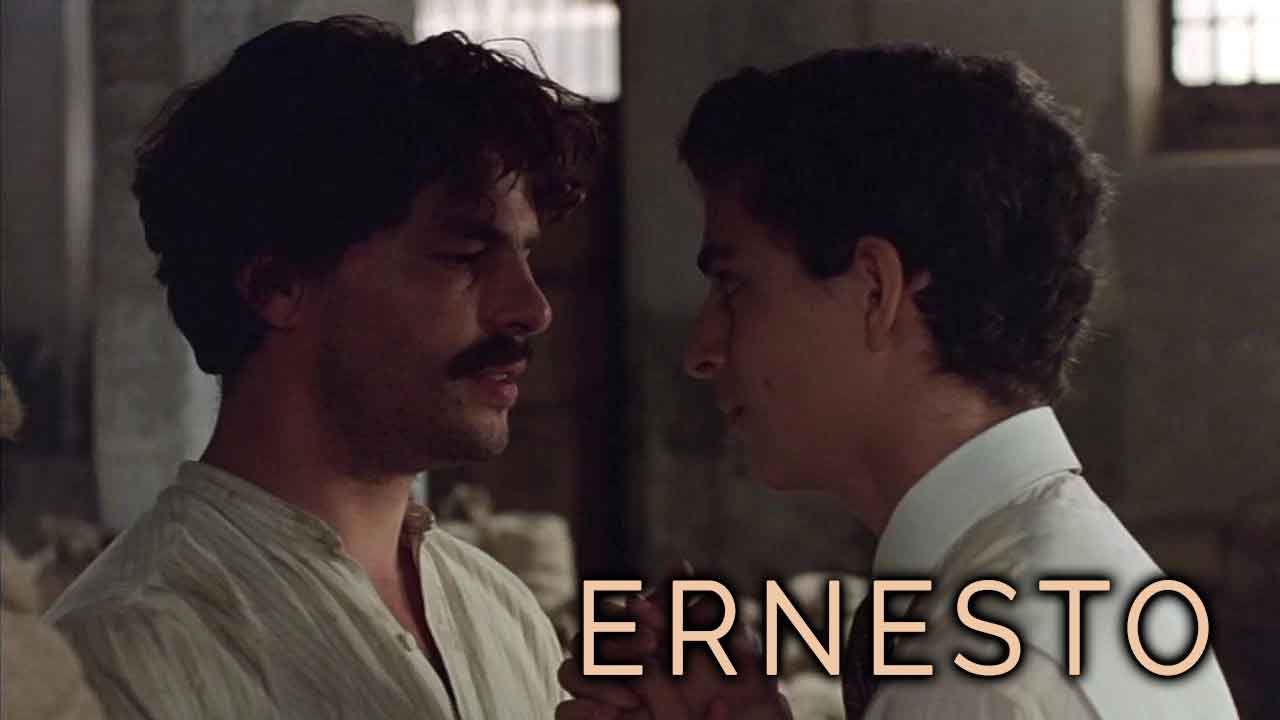
The warehouse scene is the one people remember, and rightly so. Not because it is “shocking” by modern standards, but because it is charged with much more than sex. This is where class enters the room and refuses to leave. Ernesto may have the social position, the clean collar, the authority of the young gentleman who supervises labor, but in that space the balance shifts. The worker has the experience. He has the body. He has the confidence that comes from already knowing what desire costs. Ernesto arrives with curiosity and nervous control. Placido’s character meets him with a strange combination of bluntness, reassurance, appetite, and practical knowledge.
That is what makes the scene so good. It is not sentimental and it is not coy. Ernesto asks questions like someone stepping toward a cliff and pretending he is only admiring the view. He wants rules, reassurance, a promise that things will stop if he says so. He wants to be brave and protected at the same time. The older man, for his part, does not behave like a dreamy movie lover from a perfume ad. He behaves like someone who knows exactly how bodies work, how fear works, and how quickly tenderness can turn into danger in a world that punishes what it cannot tolerate.
The result is one of those rare scenes that feels erotic, awkward, beautiful, and a little frightening all at once. Which is to say, it feels true.
Michele Placido steals the air out of every room
Michele Placido is phenomenal here because he understands that this man should never become a symbol only. He is not just “the working-class lover” or “the first temptation.” He is a full presence. He flirts with directness, carries himself with the confidence of someone who has known hunger, labor, and women, and yet when Ernesto becomes frightened or overwhelmed, there is still a rough form of care there. Not softness exactly. Not innocence, certainly. But a lived-in humanity.
Placido makes masculinity look complicated in the best possible way. His character is virile without becoming ridiculous, tender without becoming sanitized, and dominant without slipping into cartoon villainy. He is part seduction, part education, part danger. He sees Ernesto clearly for what he is: not a master, not an equal, not yet, but a beautiful boy trying very hard to sound older than he feels. That recognition is half the seduction.
And yes, Placido brings enormous erotic force to the role. The film never lets you forget the body. The sweat matters. The muscles matter. The physical labor matters. This is desire rooted in class and flesh, not in abstract longing.
The film gets even smarter once the first scandal passes
What I appreciated most is that Ernesto does not peak with the warehouse and then coast. After that first initiation, the film starts opening outward. Ernesto returns to family tensions, to his mother, to the suffocating little rituals of respectability, to politics worn half-seriously and half-defensively, to the awkward question of what kind of man he is supposed to become. There are girls, there is the prostitute scene, there is the barber with that wonderful little motif about the beard and the loss of boyhood, and then later there is the younger musical prodigy who brings a completely different energy into the film.
That is where Ernesto becomes more than a story of first homosexual experience. It turns into a portrait of adolescence as drift. Ernesto moves from one possibility to another, not because he is shallow, but because he is still under construction. He is testing versions of himself. He is trying out desire, class rebellion, sophistication, performance, honesty, and even cruelty. Some of it is comic. Some of it is painful. Almost all of it is recognizable.
The family material is especially sharp. The house is full of rules, old resentments, ethnic and religious tensions, and that uniquely suffocating family love that can smother you while insisting it is keeping you safe. Ernesto’s mother loves him, of course she does, but love in this film often arrives wrapped in control, guilt, fussing, and social anxiety. That domestic pressure is one reason the warehouse encounter hits so hard. It is not just sex. It is oxygen.
Why the film still works
What makes Ernesto linger is that it refuses to tidy youth into a respectable coming-of-age lesson. It understands that early desire is often inconsistent, funny, embarrassing, reckless, and smarter than adults think, while also being more fragile than the young person themselves wants to admit. Ernesto is not a hero in any conventional sense. He is vain, confused, curious, evasive, wounded, fascinated, and occasionally ridiculous. In other words, he is young in a very convincing way.
And that is why Michele Placido matters so much in the film. He gives Ernesto a first encounter not just with sex, but with another world: a world of labor, risk, male confidence, and unsentimental intimacy. Even when the story moves elsewhere, that encounter keeps echoing. You can feel it in the way Ernesto looks at people afterward, in the way the film keeps circling back to questions of maturity, performance, and what exactly separates a boy from a man.
Ernesto is not just a queer period piece, and it is not just a provocative relic. It is a sharp, sensual, surprisingly funny film about class, bodies, fear, and the humiliating beauty of becoming yourself one awkward step at a time. And Michele Placido, all sweat and appetite and rough-edged warmth, gives it the kind of charge that polite films spend a lifetime trying to fake.