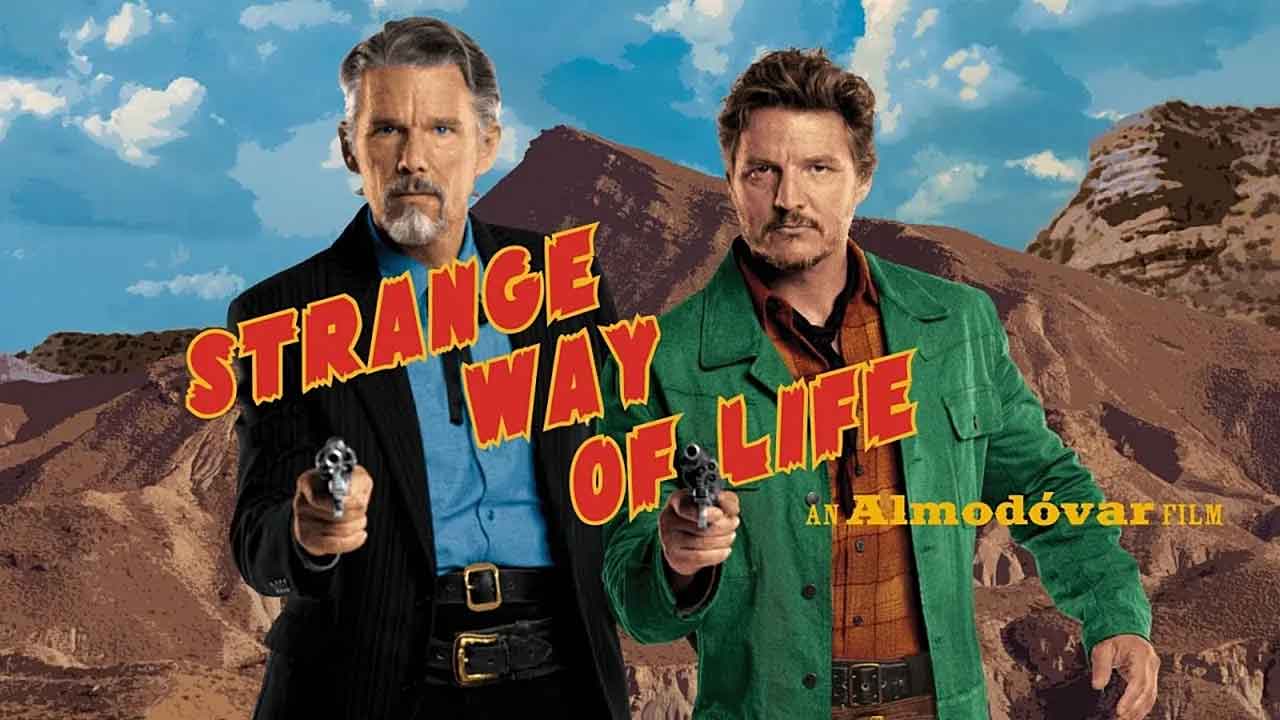




Pedro Almodóvar takes the language of the western and fills it with old desire, regret, and the kind of tension that does not need a shootout to hurt. Strange Way of Life is short, elegant, and emotionally far messier than its polished surface first suggests.


Strange Way of Life is a western on the surface, but Pedro Almodóvar has no interest in leaving it there. Beneath the sheriff badge, the horses, the rifles and the desert heat, this short film is really about unfinished love. It opens with a reunion, but not the easy kind. Silva rides across the desert to see Jake after twenty-five years, and from the moment they sit together, the film makes it clear that the past is not dead, buried, or even particularly quiet.
What follows is not a grand epic, but something smaller and more delicate. That works in the film’s favor. In just a short runtime, Almodóvar turns a simple setup into a story about memory, regret, masculinity, duty, and desire that never truly faded. It is a queer western, yes, but more than that, it is a chamber drama in cowboy boots.
Strange Way of Life turns reunion into emotional warfare
The strongest thing about the film is how quickly it establishes emotional tension without forcing it. Silva arrives with warmth and openness, carrying the past like something precious. Jake receives him with caution, like a man who has spent years learning how to survive by keeping certain doors shut. That difference defines everything that follows.
The dialogue has an intimate sting to it. These men do not speak like strangers reconnecting. They speak like people who once knew each other deeply and never found a proper ending. Silva remembers what they had with a kind of stubborn tenderness. Jake tries to reduce it, contain it, push it back into the corner where old mistakes are supposed to go. But the more he resists, the clearer it becomes that he is resisting himself as much as Silva.
There is something almost funny in the way Jake tries to remain composed while the film quietly strips that composure away. He has the sheriff’s authority, the house, the order, the rules. Silva walks in and suddenly all that masculine control starts looking very fragile. That is one of the smartest things Almodóvar does here. He shows that the toughest men in westerns are often just men hiding behind a costume that fits well in public and terribly in private.
Pedro Pascal and Ethan Hawke make the silence count
Pedro Pascal plays Silva with warmth, confidence, and just enough sadness under the surface to make every scene feel slightly bruised. He does not act like a man gambling on a forgotten romance. He behaves like someone who already knows it was never forgotten at all. Ethan Hawke gives Jake the opposite energy. He is restrained, guarded, and visibly uncomfortable with how quickly the past comes alive again.
Together, they are excellent. The chemistry is not loud or theatrical, but it is constant. It lives in pauses, glances, interruptions, and unfinished thoughts. This is not one of those films where characters need to explain everything in long speeches. The performances do the work. Pascal brings heat. Hawke brings resistance. Between them, the film finds its pulse.
That pulse matters, because without believable chemistry the whole story would collapse into a stylish exercise. Instead, it feels lived-in. You believe these two men once shared something intense, and you believe they are both still paying for it in very different ways.
A queer western where love collides with duty
Strange Way of Life becomes more interesting once it stops being only about reunion and starts pressing on consequences. Silva’s son Joe is tied to the murder Jake is investigating, and suddenly the film is not just about desire returning after years of silence. It is about what happens when private feeling crashes into public duty.
That conflict gives the story real bite. Jake is not simply a repressed man refusing happiness for no reason. He is tied to his role, to his brother, to the law, and to the identity he has built around those things. Silva is not just a romantic figure from the past either. He is also a father trying to protect his son, even while sensing that danger is circling all of them. The film never lets either man remain simple, and that complexity is exactly why it lingers.
It also helps that Almodóvar does not turn the western setting into parody. He respects its mythology while quietly dismantling it. Honor, justice, male pride, violence, loyalty, all the usual western ingredients are still present. They are just being filtered through longing instead of bravado. The result feels fresh without trying too hard to look clever.
Pedro Almodóvar brings style, but not empty style
Of course the film looks beautiful. That part is expected. Almodóvar brings color, control, sensual detail, and a polished visual language that makes even the dust feel curated. But the good news is that the style actually serves the emotion. Nothing here feels decorative for its own sake. The landscapes create distance. The interiors create intimacy. The costumes and textures underline the contrast between what these men show the world and what they are trying not to admit to themselves.
This is not the muddy, rough-edged western of old Hollywood myth. It is cleaner, more precise, more emotionally exposed. Some viewers will love that immediately. Others may wish it were harsher or more rugged. But the elegance is the point. This is a film about repression wrapped in beauty, and that combination suits it perfectly.
Why Strange Way of Life stays with you
What gives the film its quiet power is not the plot twist or the western tension. It is the ache of lost time. The story understands that love does not become less important just because years have passed. Sometimes it becomes heavier. Sometimes it turns into the thing you build your whole life around avoiding.
By the end, Strange Way of Life leaves behind the feeling of a relationship that never truly ended, only changed shape. It is about two men who still recognize each other beneath all the years, all the roles, and all the damage. That recognition is tender, but it is also cruel, because it raises the question the film never fully answers: what kind of life might they have had if they had chosen each other more openly, and sooner?
For a short film, it carries a surprising emotional weight. It does not need a long runtime to make its point. It just needs two strong performances, a sharp emotional core, and a director who understands that in the right hands, one look across a room can hit harder than a gunshot.
Strange Way of Life is not a conventional western, and thankfully it never tries to be. It is a sad, elegant, intimate story about desire, memory, and the cost of arriving too late. In Almodóvar’s hands, that turns out to be more than enough.