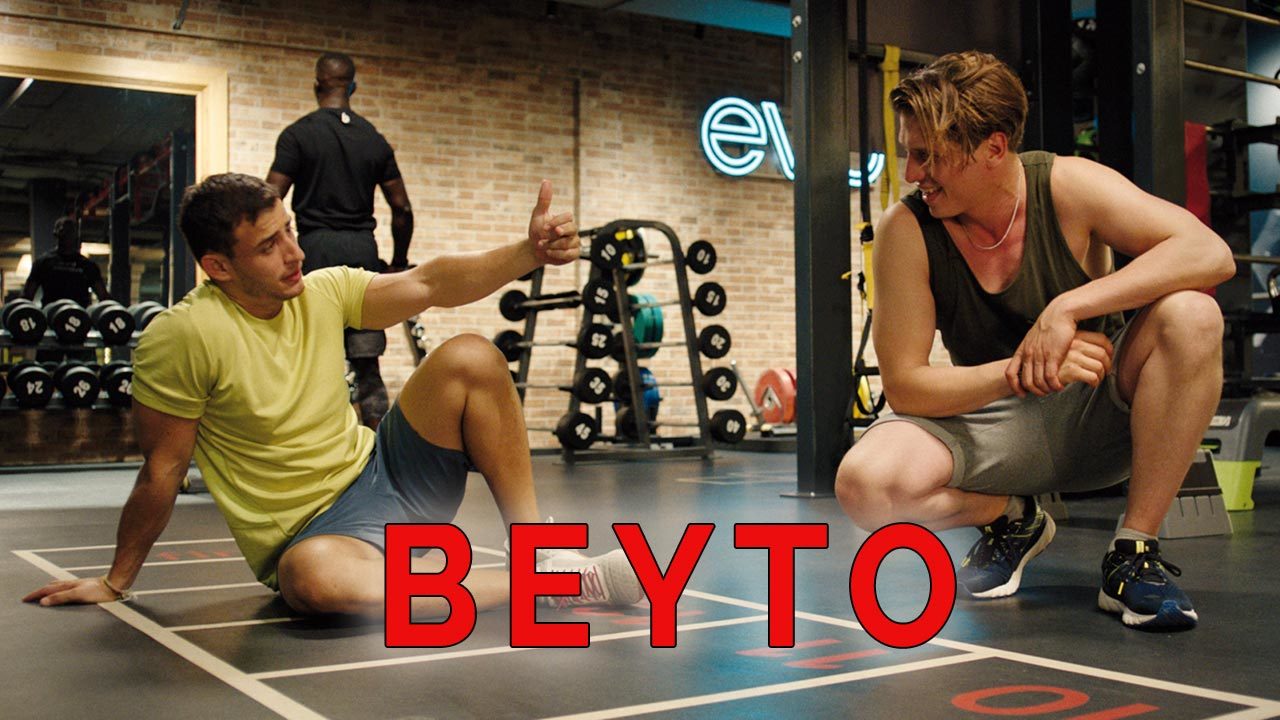




Beyto (2020): Why “Just Marry and Nobody Needs to Know” Is Brutal


“Beyto” (2020) looks at first like “just another” coming out film with conservative parents, a bit of cultural clash and a sad gay boy in the middle. But very quickly it becomes something much more uncomfortable – exactly because everything feels so normal, so everyday, that you cannot escape the thought: this is not happening somewhere far away, this could be the boy from the next building.
Our main guy is Beyto – a talented swimmer, quiet, polite, the kind of son parents love to use as primjer kada hvale sebe pred rodbinom. He lives in Switzerland, his family is from Turkey, he trains, works, behaves, does not make trouble. Perfect. Except for one detail: he falls in love with his coach, Mike.
And this is not some wild, fireworks-style movie romance. It starts with training sessions, glances, small gestures, shared dinners and the slow melting of that invisible line between “this is professional” and “we both know this is more than that”. It is intimate and ordinary at the same time – which makes it very believable.
When parents hear “shame” instead of “I love him”
The strongest moment in “Beyto” is not the kiss between Beyto and Mike. It is the moment when the truth comes out. Not with big drama and huge speeches, but in the way it usually happens in real life: someone sees something, someone hears something, someone puts two and two together – and everything starts to fall apart.
Beyto’s parents react exactly the way millions of parents still react today. Shock. Panic. Fear. Not “my child is suffering”, but “what will people say”. They do not have some sophisticated ideology behind it – this is that everyday, practical homophobia: “this is not natural, someone confused you, we know better what your life should look like”.
And because they love him in their own way, they do what they think is right. They push him into a direction that will “save” him. Translation: they drag him to Turkey and arrange a marriage with a girl from their village, Seher. A proper, traditional, family-approved solution.
This is where “Beyto” becomes truly painful. Nobody wakes up and says “today I will destroy my child’s life”. They honestly believe they are helping. Seher truly believes this is her chance at happiness. Beyto honestly believes he has no choice. That is exactly why the film hits so hard – there are no comic book villains, only people who are scared and conditioned.
Mike and Seher – two people who love the same man for very different reasons
In a weaker film, Mike would be a perfect gay savior from the West and Seher would be a one-dimensional victim. “Beyto” is smarter than that.
Mike is not a magical prince who will fix everything with one big romantic gesture. He is also confused, hurt, sometimes stubborn, but still more emotionally literate than most people around Beyto. His pain is not only “I lost my boyfriend”. It is also: “How can you pretend we did not exist just to make everyone else happy?”
Seher, on the other hand, is not there just to block the love story. She is a young woman who was taught her entire life that marriage is the main goal, the big solution. When this chance appears, of course she grabs it with both hands. She is not evil, she is not naive – she is simply trapped in a system where her worth depends on being “a good wife and a good daughter-in-law”.
The saddest part is that both Mike and Seher genuinely care about Beyto, each in their own way. And that honest love is exactly what makes all three of them suffer even more.
Silence as the main villain
The film’s true antagonist is not religion, not tradition, not “the West versus the East”. It is silence.
Silence at the family table when everybody knows something is wrong, but nobody dares to say it out loud. Silence between Beyto and his parents, where one honest conversation could save half of this disaster – but never happens. Silence in the bedroom with Seher, where there is physical closeness on paper, yet an emotional wall so high that neither of them can even see the top.
There are no Oscar monologues, no ten-minute speeches that fix everything. Instead we get short sentences, broken attempts, eyes that look away. That feels brutally real. Most families do not sit down and unpack their trauma in a structured dialogue. They change the topic. They go out to smoke. They say “we will talk later” and never do.
Why this film matters – beyond queer cinema
“Beyto” shows how far people can go – not because they are monsters, but because they are afraid. Afraid of God, neighbours, gossip, relatives, of losing the illusion of a “normal family”. It shows how quickly love turns into manipulation when image becomes more important than truth.
The film also draws a very clear line: tradition without empathy is simply a more polite form of violence. There are no fists, no prisons, no public humiliation. But there is emotional blackmail, lies, pressure and forcing someone into a marriage that kills their sense of self. From the outside it looks civilized. From the inside it feels like a sentence.
And maybe the most important point: “Beyto” does not lie to you with a perfectly neat happy ending. There is no magic solution where parents evolve overnight, husband and wife become best friends, and the boyfriend cheerfully joins for Sunday lunch. Some things can be healed, yes. But someone will still carry the scars. Somebody will always feel that they have betrayed themselves or others.
For everyone who still says “just marry, nobody needs to know”
If you ever need to explain to someone why “just marry a woman and live your life on the side” is not a harmless compromise, show them this film.
“Beyto” is a quiet, intimate reminder that there are always more than two people in that lie. There is the man who divides himself in half. There is the woman who did not sign up to be a cover story. There are parents who think they fixed everything, but actually pushed their child further away. And there is a whole community that would rather pretend not to see the damage than admit they might be part of it.
It is not a loud film. It will not scream at you. But it will sit in your head afterward and make you remember at least one person you know who might be living something very similar – just without the camera and the end credits.