

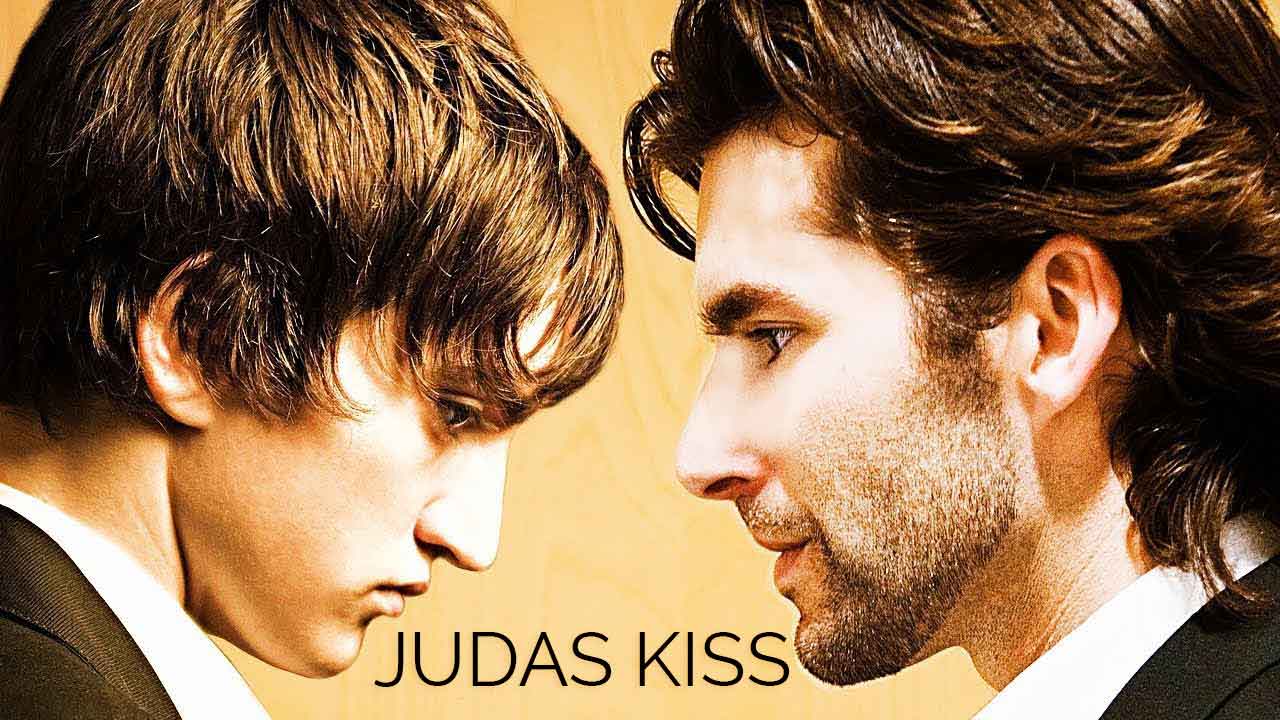



What if the worst choices you made in your twenties showed up in front of you – wearing your old name and your old dreams?


Judas Kiss (2011) plays with that terrifying, tempting thought and asks a simple question: if you could fix the past, would you actually change?
Judas Kiss (2011): Why this little indie still hits
Let’s set the scene. Zach Wells (Charlie David) is a filmmaker who never quite became the filmmaker. He returns to his old university as a guest judge for a student film festival, pretending he’s fine. He isn’t. Then he meets a cocky first-year named Danny Reyes (Richard Harmon) – which, awkward detail, used to be Zach’s name – who just submitted a short that looks suspiciously like the film Zach made years ago.
It’s not subtle. It’s not meant to be. Judas Kiss is a queer indie that wears its premise on its sleeve and goes all-in on second chances, self-loathing, and the weird time-loop energy of meeting a version of yourself you’d rather forget.
Plot without spoiling the whole cake
Zach arrives, flirts, self-sabotages – and wakes up inside a moral funhouse. The campus, the festival, the “rules” of cause and effect: they all become mirrors. Danny is talented, reckless, eager to cheat his way up. Sound familiar? Zach’s choice is the core engine: call out the kid and risk blowing up his future, or quietly enable him like the industry often does.
It’s a time-travel story without DeLorean doors – the time machine is recognition.
Characters that make the loop worth it
Zach carries that specific queer creative fatigue – the kind that turns charm into armor. Charlie David plays him as a man who knows how to pose confidence while privately counting losses.
Danny (Richard Harmon) is all teeth and talent – a believable cocktail of hunger and denial. He’s not a villain; he’s twenty and wants something now.
Chris (Sean Paul Lockhart) brings a welcome reality check to the Zach–Danny axis, while Shane (Timo Descamps) and Abby (Allison Lane) add texture to the campus orbit. No performance breaks the indie ceiling – but they fit the film’s earnest frequency.
What the film is really about
Not really time travel. Not even just “LGBT representation.” Judas Kiss is about the quietly radical act of telling the truth when lying gets rewarded. It’s about the way ambition can warp into shortcuts, and how the closet isn’t only about sexuality – it’s about hiding the parts of your craft you think no one will love.
Theme notes (for the film nerds):
- Second chances: The festival is a ritual; the loop is a confession booth.
- Authorship vs. ownership: Who “owns” a story – the one who lived it, or the one who sells it better?
- Queer coming-of-age, twice: Once at twenty, once at thirty-something, both messy and real.
Where it stumbles (indie budget meets big ambition)
You’ll feel the budget. Some transitions are blunt, and the time-bending logic works more like a fable than a puzzle box – don’t expect primer-tight sci-fi rules. A couple of emotional beats arrive a touch early, the staging leans TV at times, and the script occasionally states what the frame already shows. Still, the sincerity is disarming; the film believes in its characters, and that carries it.
Should you watch it?
If your shelf already says gay themed movies and you keep a soft spot for generous indie dramas, yes. Judas Kiss won’t change cinema, but it might nudge a few hearts – especially if you’ve ever wished to email your younger self a paragraph that starts with “Listen.”
For a late-night, headphones-on session, it’s a worthy 90-ish minutes.








1 comment